How Much a Token Costs: The Real Price of AI Adoption
Rashad Cureton
Founder, Cure Consulting Group
The Price on the Box Is Not the Price You Pay
There is a number that appears in nearly every pitch deck, investor memo, and LinkedIn thought-leadership post about artificial intelligence in 2026: the cost of a token. At current rates, sending a thousand words to GPT-4o costs about a quarter of a penny. Claude Sonnet processes the same for roughly a third of a cent. Gemini Flash will do it for even less.
These numbers are real. They are also, for any business attempting to do something useful with AI, almost entirely beside the point.
Over the past several years — first at JP Morgan and Ford, and now running an engineering consultancy — I have watched dozens of companies adopt AI with budgets built around token pricing. The pattern is remarkably consistent: the API bill comes in low. Everything else comes in high. The resulting gap between expectation and reality has become, in my experience, the defining miscalculation of the current AI era.
What a Token Actually Costs
The current pricing landscape, for reference:
| Model | Input (per 1M tokens) | Output (per 1M tokens) |
|---|---|---|
| GPT-4o | $2.50 | $10.00 |
| Claude Opus 4 | $15.00 | $75.00 |
| Claude Sonnet 4 | $3.00 | $15.00 |
| Gemini 2.5 Flash | $0.15 | $0.60 |
| Gemini 2.5 Pro | $1.25 | $10.00 |
Where the Money Actually Goes
When a company moves from demo to production — and it is striking how many never do — the costs arrange themselves into a familiar pattern:
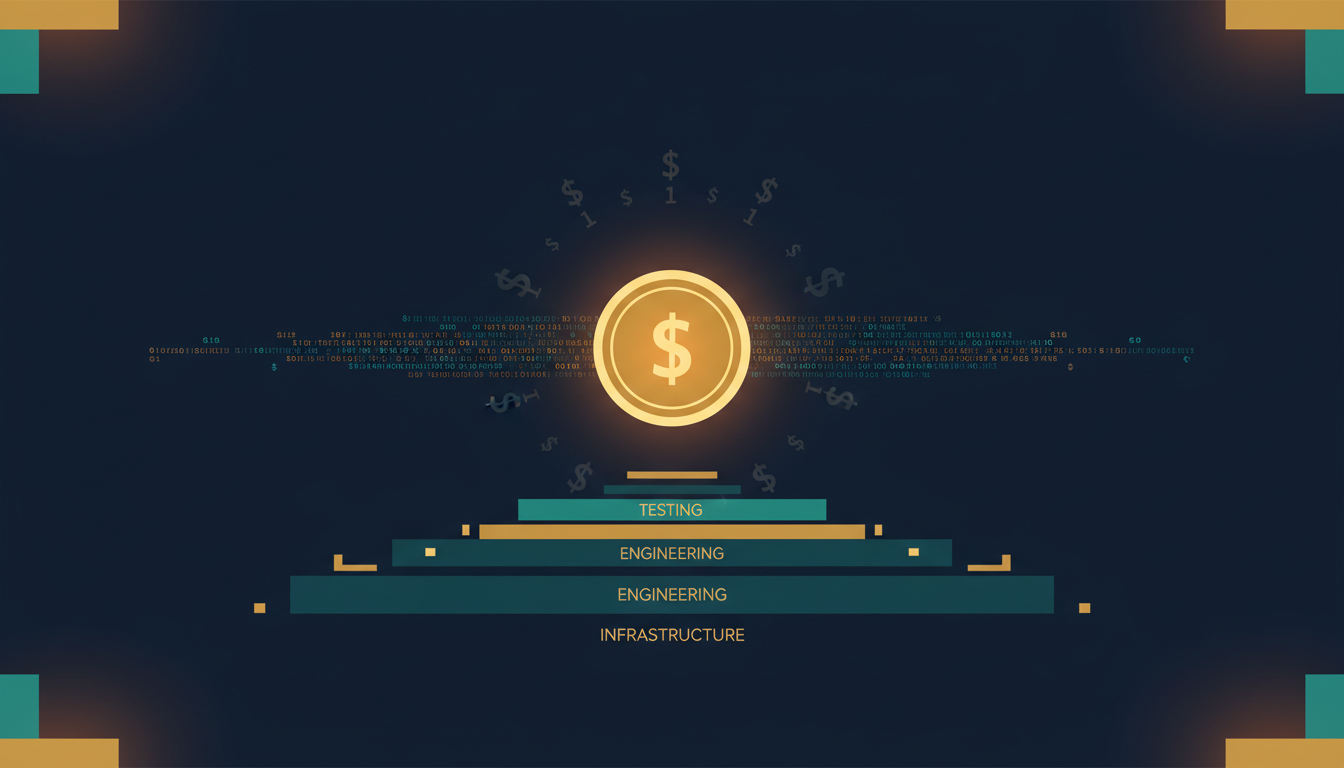
Step 1: Infrastructure & API — $1,500 to $8,000 per month
API calls to model providers, vector databases for retrieval, embedding pipelines, cloud compute for fine-tuning, and observability tooling. This is the line item everyone budgets for. It is, almost without exception, the smallest one.
Step 2: Engineering Integration — $25,000 to $80,000
Prompt engineering and optimization. RAG pipeline architecture. Integration with existing databases, authentication systems, and business logic. Error handling. Rate limiting. Security review. This is where the actual money goes — building the connective tissue between a language model and a real product.
Step 3: Testing & Evaluation — $8,000 to $20,000
You cannot unit test a probabilistic system the way you test a deterministic one. Evaluation datasets, hallucination detection, regression testing when prompts change, A/B frameworks — the testing infrastructure for AI features is its own small engineering project.
Step 4: Ongoing Operations — $3,000 to $12,000 per month
Models change. Providers deprecate versions without much ceremony. Prompts that performed beautifully in March produce nonsense in April because the underlying model was updated. AI is not a deploy-and-forget technology. It requires continuous attention in a way that a well-written REST endpoint does not.
Step 5: Opportunity Cost
Perhaps the most expensive line item is the one that never appears on a spreadsheet. Every engineer building AI features is an engineer not building the product feature your users actually requested last quarter. This tradeoff is real, and companies that fail to account for it tend to discover it at the worst possible moment.
The Question Behind the Question
Get insights like this in your inbox
Practical tips on AI, mobile & cloud — no spam.
The cost discussion inevitably arrives at a more charged question: will AI replace software engineers?
The short answer is no. The longer answer is more interesting.
Where AI Excels | Where AI Falls Short
I use AI tools daily. Claude writes code alongside me. Gemini generates images for this publication. These tools have made me meaningfully more productive. But productivity is not the same as replacement, and the distinction matters.
The engineers most at risk are not those who will be replaced by AI, but those who decline to work alongside it. The ones who thrive will treat it as a power tool — not a substitute for judgment.
”What is actually happening in the market, stripped of narrative convenience:
Entry-level roles are compressing. Work that once occupied a junior engineer for three days now takes a senior engineer with AI assistance three hours. Companies are not eliminating engineering positions. They are hiring fewer junior engineers and expecting more architectural fluency from everyone else.
The bar is rising quietly. A developer whose primary skill was translating Stack Overflow answers into production code has, in effect, been automated. A developer who understands systems design, user needs, and technical tradeoffs has been given a force multiplier.
The actual shortage is AI-literate engineers. Among the forty-odd client organizations I work with, not one has reduced engineering headcount because of AI. The complaint I hear most often is the opposite: they cannot find enough engineers who know how to use these tools well.
Three Scenarios, Honestly Priced
Consider a mid-size SaaS company with ten engineers that wants to add AI capabilities to its product:
Scenario A: The API-Only Approach
- ChatGPT Plus for 10 seats: $2,400/year
- Product API costs: ~$3,000/month
- Year 1 total: ~$38,400
This buys internal productivity tooling and, perhaps, a chatbot that occasionally invents your own pricing. It does not buy a production AI feature.
Scenario B: Building In-House
- API & infrastructure: ~$5,000/month ($60K/year)
- Engineering (2 engineers, 4 months): ~$120,000
- Testing & evaluation: ~$15,000
- Ongoing maintenance: ~$6,000/month ($72K/year)
- Year 1 total: ~$267,000
This buys AI features that work reliably, handle edge cases, and do not embarrass you in front of paying customers. It also takes roughly a year to reach maturity.
Scenario C: Working with a Firm That Has Done This Before
- Scoping & architecture: $5,000-10,000
- Implementation: $50,000-100,000
- Knowledge transfer to your team
- Total: $55,000-110,000, shipping in 3-6 months
What the Disciplined Companies Do Differently
The organizations extracting real value from AI share a small set of habits:
They start with one workflow, not a platform. Rather than building "an AI layer," they identify a single expensive manual process and automate it. They prove ROI before expanding scope.
They budget for integration, not just inference. When 90% of the AI budget goes to API costs and 10% to engineering, the ratio is inverted from where it should be.
They keep humans in the loop. The most reliable AI systems are not fully autonomous. They handle 80% of the work and route the remaining 20% to a human for verification. This is cheaper — often dramatically so — than cleaning up after a fully autonomous system that gets something wrong.
They measure relentlessly. Cost per request. Latency. Accuracy. User satisfaction. If a metric cannot be tracked, the spend cannot be justified — certainly not to a CFO who has seen this movie before with other technologies.
They invest in literacy, not just tooling. The companies that outsource their entire AI strategy to a vendor who profits from their confusion tend to remain confused. The better approach is to learn enough to ask sharp questions, then bring in specialists to build the answers.
The Takeaway
A token costs a fraction of a penny. Bringing AI into production costs real money — typically $50,000 to $250,000 or more for a mid-size company doing it properly. The technology does not replace engineers. It changes what engineering looks like, and it rewards the companies that approach it with discipline rather than enthusiasm alone.
The firms that will look back on 2026 as the year AI started paying for itself will not be the ones that spent the most. They will be the ones that spent carefully — choosing the right problem, building the right solution, and understanding that the cost of a token was never really the question.
Evaluating whether AI makes sense for your business? Book a free architecture review — we will audit your workflows, estimate real costs, and give you an honest assessment. No pitch deck, just arithmetic.
Written by
Rashad Cureton
Founder & Principal Engineer
Rashad is the founder of Cure Consulting Group. Previously an engineer at JP Morgan, Ford, Clear, NYT, Kickstarter, and Big Nerd Ranch. He builds full-stack web and mobile apps for startups and companies of every size.
Related Articles
Claude vs. Gemini vs. GPT: An Honest Comparison for Business Leaders (2026)
We use all three AI platforms at Cure Consulting — here's an honest, experience-based breakdown of when to use Claude, Gemini, or GPT for real business tasks. No vendor hype, just what actually works.
12 min
GPT 101: The Business Leader's Guide to OpenAI's AI
GPT and ChatGPT aren't just the most popular AI — they've built the largest ecosystem of plugins, custom bots, and enterprise integrations in the industry. Here's how to leverage OpenAI's platform for your business.
10 min
Gemini 101: The Business Leader's Guide to Google's AI
Gemini isn't just Google's answer to ChatGPT — it's the first AI built natively for multimodal understanding. Here's how its deep Google ecosystem integration creates unique advantages for businesses already running on Workspace.
10 min